
Reviewed · CITY TOURS
Pretoria City Tour
Pretoria City Tour is a compact crash course in South Africa’s turning points. You go from pioneer-era ambition to government power, then to human-rights remembrance, all in a few hours.
I like that this tour is private, so you are not stuck with a random pace or random interests. I also love the focus on specific places, from the Voortrekker Monument to Freedom Park, instead of vague drive-bys.
One consideration: two major stops have admission tickets not included, so budget a little extra for entrance fees on the day.
In This Review
- Key highlights you should know
- Pretoria (Tshwane) is more than a stopover
- Is the price ($108.52) fair for a 4 to 5 hour guided history sprint?
- Pickup comfort, private pacing, and how that changes the day
- Voortrekker Monument plus the Presidential Resident, where history gets physical
- Church Square, Marthinus Pretorius, and the market-and-church layout
- UNISA and Pretoria’s academic identity, measured at mega-university scale
- A scenic break in the Apies River area, Paul Kruger’s nature reserve, and trek ruins
- Union Buildings at Meintjieskop, light sandstone and government power
- Freedom Park on Salvokop Hill, human rights and memory you can’t rush
- What makes this tour feel special: the guides
- Who should book this Pretoria city tour?
- How to plan your half-day so you enjoy every stop
- Should you book it?
- FAQ
- How long is the Pretoria City Tour?
- What is the price per person?
- Do I get pickup?
- Is this a private tour?
- Are admission tickets included?
- Is lunch included?
- Is bottled water included?
- Can I cancel for free?
- Are service animals allowed?
Key highlights you should know
- Voortrekker Monument guided storytelling on pioneers, including major 19th-century themes
- Presidential Resident details like the first Pretoria building lit by electricity, plus the unusual milk-in-cement anecdote
- Church Square in the historic core where the market-and-church layout shaped early Pretoria life
- UNISA at city scale and why Pretoria earns its reputation as an academic hub
- Union Buildings views from Meintjieskop with the light-sandstone architecture by Sir Herbert Baker
- Freedom Park memorials tied to South African Wars, World Wars, and apartheid-era remembrance
Pretoria (Tshwane) is more than a stopover
Pretoria, part of Tshwane, is one of South Africa’s three capital cities. Cape Town is the legislative capital, and Bloemfontein handles the judicial side, while Pretoria runs the administrative branch and hosts many foreign embassies.
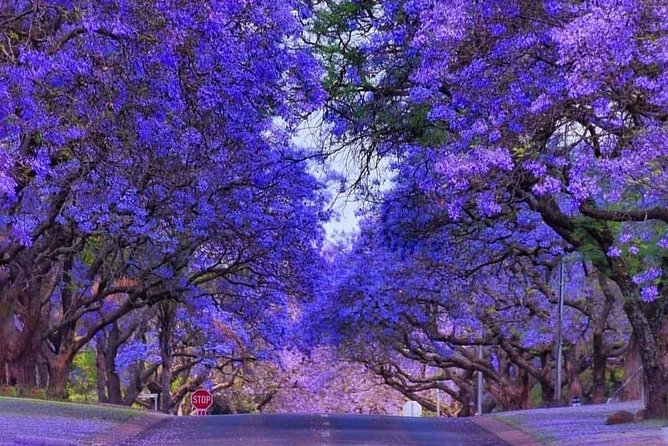
It also has an academic feel, with three universities and major research institutions like the CSIR and the Human Sciences Research Council. Add the nickname Jacaranda City, and you get a place that can look plain in daylight and then shift to purple in spring.
If your idea of a “cool city” is big street life and headline-grabbing architecture, Pretoria can feel quieter. If you enjoy ideas, context, and “why this place matters,” you will be in the right mood.
More City Tours in Johannesburg
- Johannesburg Hop-On Hop-Off City Tour with Soweto Option
★ 4.5 · 768 reviews - Jo’berg in 1 Day: Soweto, Apartheid Museum & City Tour
★ 4.8 · 524 reviews - Soweto: Hop-On Hop-Off Bus, City Tour and Apartheid Museum
★ 4.5 · 250 reviews
Is the price ($108.52) fair for a 4 to 5 hour guided history sprint?
At $108.52 per person for about 4 to 5 hours, you are paying for two things: guided interpretation and comfortable transport. The tour includes an air-conditioned vehicle, private transportation, and bottled water, which matters in warm African weather when you want your day to feel easy rather than rushed.
You also get the flexibility of pickup and a pace that works for your group. That private format is a big value lever, because you can ask questions and steer the focus toward what you care about.
The tradeoff is simple: some key sites are not included. Voortrekker Monument and Freedom Park both note admission tickets not included, while Church Square and Union Buildings are free admissions. So plan on a small add-on cost for ticketed stops.
Pickup comfort, private pacing, and how that changes the day
The tour is set up as a private experience, meaning only your group participates. That tends to make a difference with history tours, where people often have different tolerance for sitting, walking, and photos.
You also get pickup offered, plus an air-conditioned vehicle and bottled water. For a half-day, it is a smart combo: you spend your energy on the sights, not on logistics, and you arrive less sweaty and more ready to listen.
You’ll also have a mobile ticket. That is one less thing to manage once you are out in the city.
Voortrekker Monument plus the Presidential Resident, where history gets physical
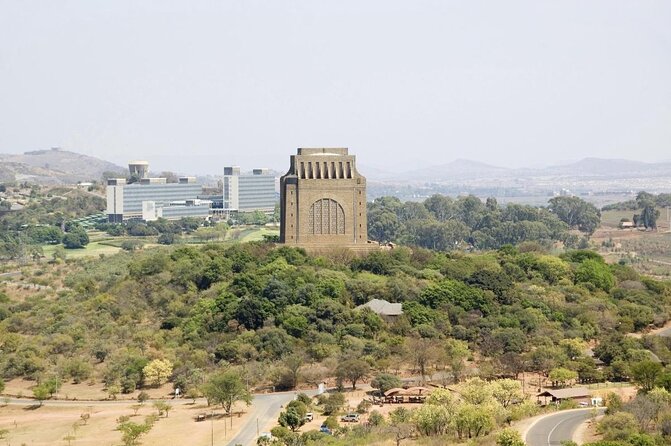
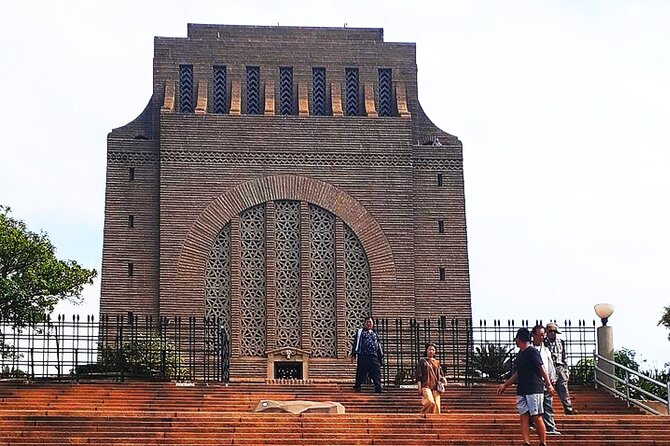
Your first major stop is the Voortrekker Monument, with a guided tour focused on pioneers from the Cape into the interior, spanning the 1836 to 1837 era themes. This is one of those places where the guide’s storytelling really matters, because the site is built to explain long arcs, not just one moment.
And you do not just get a “stand and read” experience. The tour is designed as a guided history lesson, with time built in (about 1 hour) so the context can land.
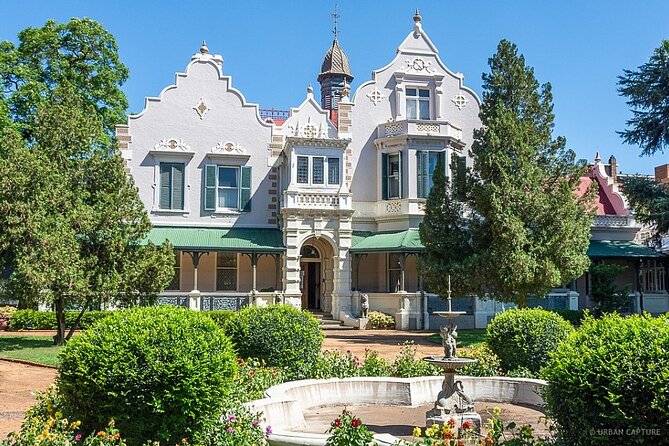
Right around this early-journey theme is the Presidential Resident, noted as the first in Pretoria to be lit by electricity. The house also includes a fascinating “House with a Taste” detail: milk was used instead of water for mixing cement, because the cement available was of poor quality. It is the kind of practical, slightly surprising fact that makes the past feel real.
One practical consideration: since admission tickets are not included here, bring a bit of flexibility in your budget. Also wear comfortable shoes, since you will likely spend some time moving around.
A few more Johannesburg trips worth comparing
- From Johannesburg: Pilanesberg Nature Reserve Game Safari
★ 4.8 · 1,327 reviews - Johannesburg: Hop-On Hop-Off Bus with Optional Soweto Tour
★ 4.6 · 985 reviews - Soweto /Johannesburg and Apartheid Museum Guided Full Day Tour
★ 5.0 · 932 reviews - Full Day Ultimate Pilanesberg National Park Safari from Johannesburg or Pretoria
★ 4.5 · 718 reviews
Church Square, Marthinus Pretorius, and the market-and-church layout
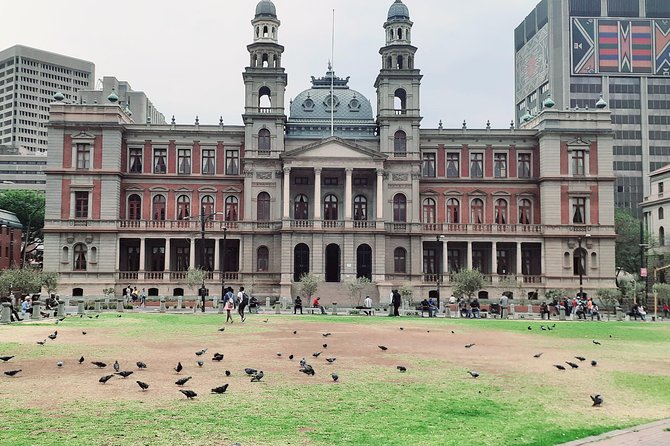
Church Square is where you see Pretoria’s historic center in a concentrated dose. The founder, Marthinus Pretorius, set it up to serve as a market place and church yard, and the church buildings at the center anchored the square from 1856 to 1905.
This is a good stop for two reasons. First, the square helps you understand how early Pretoria organized public life. Second, it gives you a calm visual reference point before you jump back into “power and memorial” territory.
You get about 30 minutes here, and admission is free. That makes it a solid value add, especially if your day includes ticketed sites later.
UNISA and Pretoria’s academic identity, measured at mega-university scale
Near this central area, you also get context on UNISA, the University of South Africa. It is described as the largest university system in South Africa and Africa by enrollment, with over 300,000 students and international students from 130 countries.
The tour highlights UNISA’s roots too. Founded in 1873 as the University of the Cape of Good Hope, it spent much of its early life as an examining agency linked to Oxford and Cambridge. Then in 1946, it became a distance education university.
Why does this matter for you as a visitor? Because it explains why Pretoria feels like an academic city rather than only a government city. If you are the type who likes to connect dots, this stop helps you understand the “mindset” behind the city’s institutions.
If you prefer purely outdoor sights and minimal explanation, you might find the education focus a bit more classroom-like than expected. Still, it is short and grounded in scale, not jargon.
A scenic break in the Apies River area, Paul Kruger’s nature reserve, and trek ruins
Between the central sights and the government hilltop stops, the tour includes context around nature and the land’s longer story. You hear about a nature reserve proclaimed by President Paul Kruger on 1 February 1895. It is listed as a 60 ha reserve, and paired with the contiguous Groenkloof Nature Reserve, described as the oldest nature reserves on the African continent.
You also get the setting details: the Apies River flows through the resort, with two natural water sources in the area. The resort is described as having facilities like a caravan park, swimming pool, lapa, playground, and barbecue facilities, plus nearby historic ruins of a house linked to Lucas Cornelius Bronkhorst (1795 to 1875).
Those ruins connect to deeper movement during the Great Trek. The Bronkhorst family is noted as part of Hendrik Potgieter’s trek party, and as the first owners of the farms in the district where Pretoria was later established.
This section is not just nature trivia. It is a reminder that Pretoria’s story is not only politics and monuments. The land itself, water, and settlement patterns all shaped what came next.
If you are prone to motion sickness, remember this is still a city tour with vehicle time, so it helps to sit where you feel most comfortable.
Union Buildings at Meintjieskop, light sandstone and government power
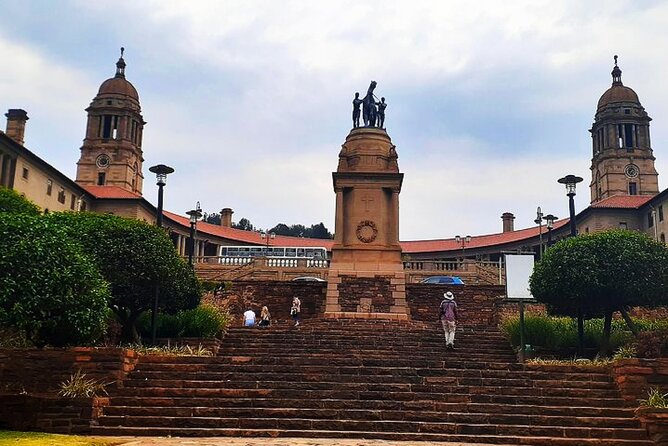
Union Buildings is the government seat and a South African national heritage site, sitting on the highest point of Pretoria at Meintjieskop. You get about 45 minutes at this stop, and admission is free.
Architecturally, the buildings are light sandstone and attributed to Sir Herbert Baker. The notes also connect Baker to major projects in New Delhi, which you do not need to know to enjoy the effect, but it does underline his international role.
From here, you feel why Pretoria is the administrative capital. This is the physical stage for official power, and the hilltop setting makes it easier to understand the city’s layout and hierarchy.
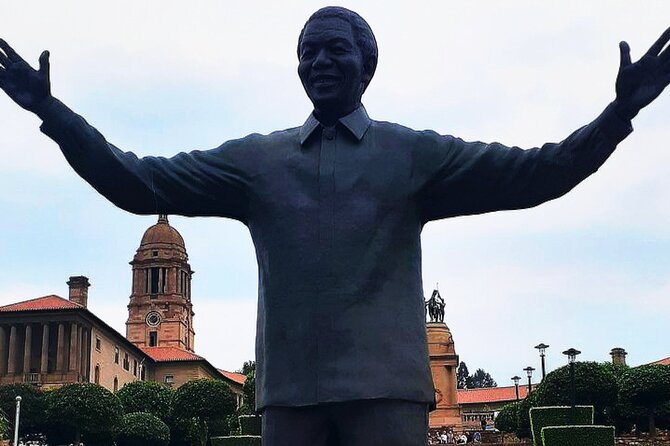
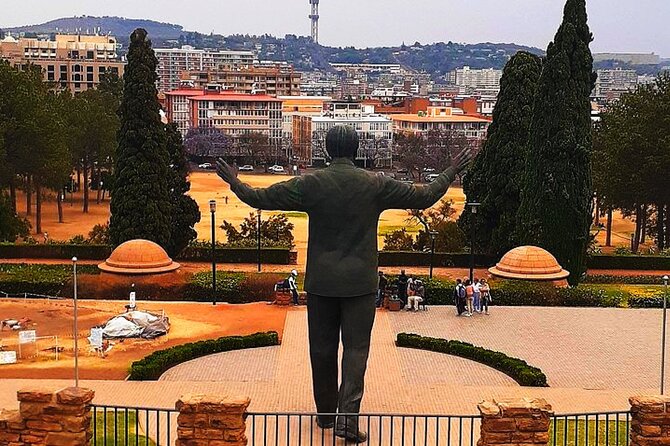
One review detail that stood out: a visit connected to Nelson Mandela was described as emotionally intense. Even if you are not obsessed with statues, this is the kind of place where symbolic moments can hit harder than you expect.
Practical tip: bring your camera, but also bring your attention. The architecture plus the hilltop viewpoint makes it worth slowing down for a few minutes.
Freedom Park on Salvokop Hill, human rights and memory you can’t rush
Freedom Park is a heritage site and museum set on Salvokop Hill. It is dedicated to the memory of those who fought for freedom and human rights in South Africa, and it links memorial sites by shared themes.
You get around 2 hours here, which is the right amount of time for a place like this. The memorial includes a list of names of those killed in the South African Wars, World War I, World War II, and during the apartheid era.
This stop is heavy, and that is not a criticism. It is the point. If you rush through, you miss why Freedom Park is effective. The tour format gives you time to take it in without turning it into a checklist.
Admission tickets are not included, so this is another spot where you should expect extra cost on the day. The upside is that it usually becomes the emotional anchor of the tour, the moment that makes the earlier history feel more personal.
What makes this tour feel special: the guides
The biggest difference in a history tour is often the guide. In the feedback, guides like Martin and Lesiba (sometimes spelled Lebisa) are singled out for style and care.
Martin is praised for being excellent, knowledgeable in the way that keeps things clear, and for taking time and initiative. Another guide experience describes Freedom Park as moving and memorable, with Martin making the whole tour feel enjoyable.
Lesiba (spelling varies in notes) is repeatedly mentioned for tailoring the tour to what you care about. One guest specifically wanted a focus on Boers and the development of Afrikaans, and described the guide as balanced and humble while sharing that history. That tailoring matters because Pretoria’s story can be told from different angles, and you get the best results when the guide adjusts to your interests.
If you have specific topics you want covered, say them early. You can ask for an emphasis on pioneers, Afrikaans development, the arc from older conflicts to apartheid-era remembrance, or the architectural angle of Union Buildings.
Who should book this Pretoria city tour?
This tour is best for you if you want a short, guided introduction to Pretoria’s key identity: pioneers, government, and human-rights remembrance. It works well for couples, solo travelers, and small groups who want to learn without organizing tickets and transport between sites.
It also suits first-time visitors from Johannesburg who want a structured half-day with pickup and less guesswork. If you only have a few hours and you still want the “why this city matters” angle, this format is a good fit.
If you want a carefree sightseeing day with shopping breaks and lots of free time to wander, this may feel more lecture-like than you expect. Pretoria is not sold as a theme-park city. It is sold as a place with ideas, institutions, and memory.
How to plan your half-day so you enjoy every stop
Start by setting expectations. This is a history-forward loop with specific sites, not a casual stroll. Build your day around it so you are not rushing from one appointment to another.
Bring sun protection and water even though bottled water is included. Also wear comfortable shoes, since the monumental sites involve time on foot.
If you care about Afrikaans history or Boer-era context, tell your guide up front. Based on the feedback, guides here can adjust their focus, which can make the tour feel like it was made for your questions rather than forced onto a fixed script.
Finally, do not treat Freedom Park as an optional add-on. If you truly want the tour to make emotional sense, give it the full attention the time allows.
Should you book it?
Yes, you should consider booking this Pretoria city tour if you want a high-value half-day with pickup, air-conditioned transport, and a tight set of meaningful stops. The free admissions at Church Square and Union Buildings help the math, and you still get time at the ticketed heavyweights like Voortrekker Monument and Freedom Park.
I would skip it only if you strongly prefer light, purely scenic sightseeing over context-heavy history. Pretoria rewards curiosity, and this tour leans into that.
If you are the kind of traveler who likes to ask why things are where they are, who built them, and how the country’s past shaped the present, you will likely come away with a far clearer mental map of Tshwane.
FAQ
How long is the Pretoria City Tour?
The tour lasts about 4 to 5 hours.
What is the price per person?
The price is $108.52 per person.
Do I get pickup?
Yes, pickup is offered.
Is this a private tour?
Yes. It is listed as a private tour/activity, meaning only your group will participate.
Are admission tickets included?
Admission tickets are not included for the Voortrekker Monument and Freedom Park. Admission tickets are free for Church Square and Union Buildings.
Is lunch included?
Lunch is not included. Lunch or a single drink can be added to the full day tour, but brunch is not included.
Is bottled water included?
Yes. Bottled water is included.
Can I cancel for free?
Free cancellation is available. You can cancel up to 24 hours in advance for a full refund.
Are service animals allowed?
Yes, service animals are allowed.
Newest around Johannesburg
- Zulu Food Cooking & Dining Experience with a local Chef★ 4.4 · 5 reviews
- Private Soweto Tour 5 hours approximately from Johannesburg or Pretoria.★ 4.5 · 9 reviews
- bicycle tour soweto★ 4.5 · 20 reviews
- Two day Kruger National Park Safari from Johannesburg★ 5.0 · 19 reviews
- Sun City Day Tour From Johannesburg★ 4.5 · 6 reviews
- Taste of Africa★ 5.0 · 9 reviews
- Full-day Johannesburg Bike Or Walking tour – With Transport★ 5.0 · 10 reviews
- Soweto Township Tours★ 4.5 · 6 reviews
City Tours, compared.
Cape Town Hop-On Hop-Off City Tour with Optional Cruise
Read our review →
Johannesburg Hop-On Hop-Off City Tour with Soweto Option
Read our review →
Jo’berg in 1 Day: Soweto, Apartheid Museum & City Tour
Read our review →
Cape Town City Pass: Save Over 50% on 80+ Top Attractions
Read our review →
Hop-On Hop-Off Bus, City Tour and Apartheid Museum
Read our review →
Browse the lists this tour appears in